
Enterprise AI context control plane

Control the context behind every AI decision.

Outer Syntax centralizes approved organizational context, mediates it into AI requests, validates responses, and gives teams measurable evidence of what worked.

Keep the AI tools you already use. Add one control point for the organizational context moving through them.

Working productExample workspace data
View larger
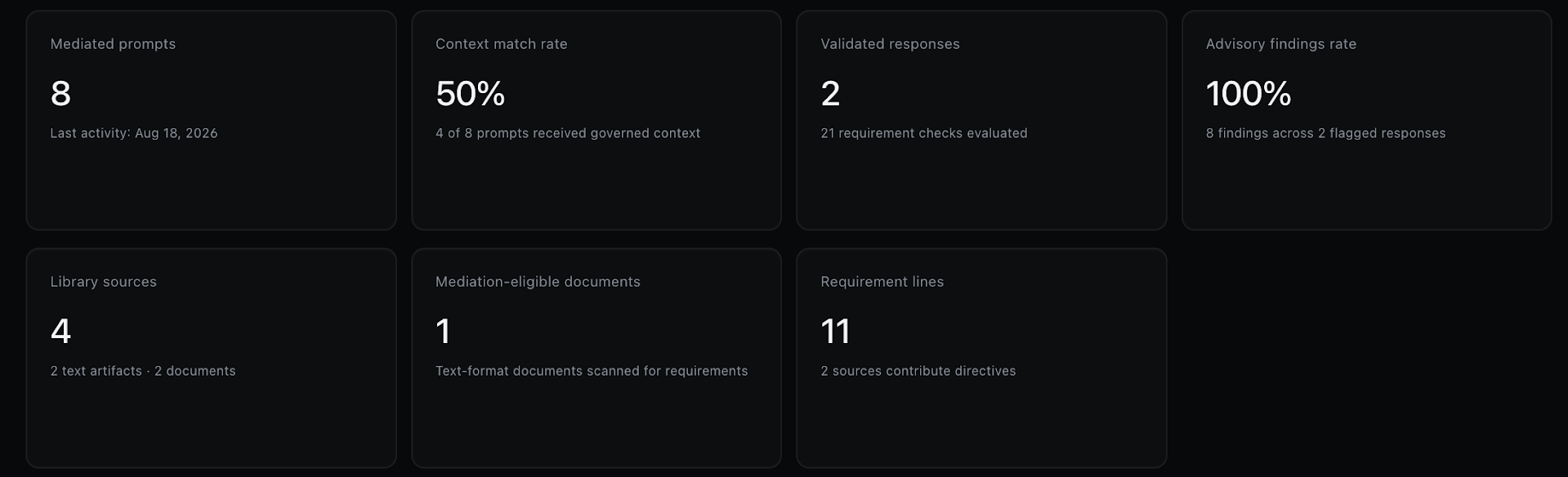
Outer Syntax product dashboard showing example workspace metrics for mediated prompts, context match rate, validated responses, advisory findings, library sources, mediation-eligible documents, and requirement lines.

One governed path for

Product evidence

See the control plane at work.

These screens show Outer Syntax working today. Development continues, and the example workspace data keeps customer information out of public product views.

01 / Analyze

Turn policy gaps into clear next actions.

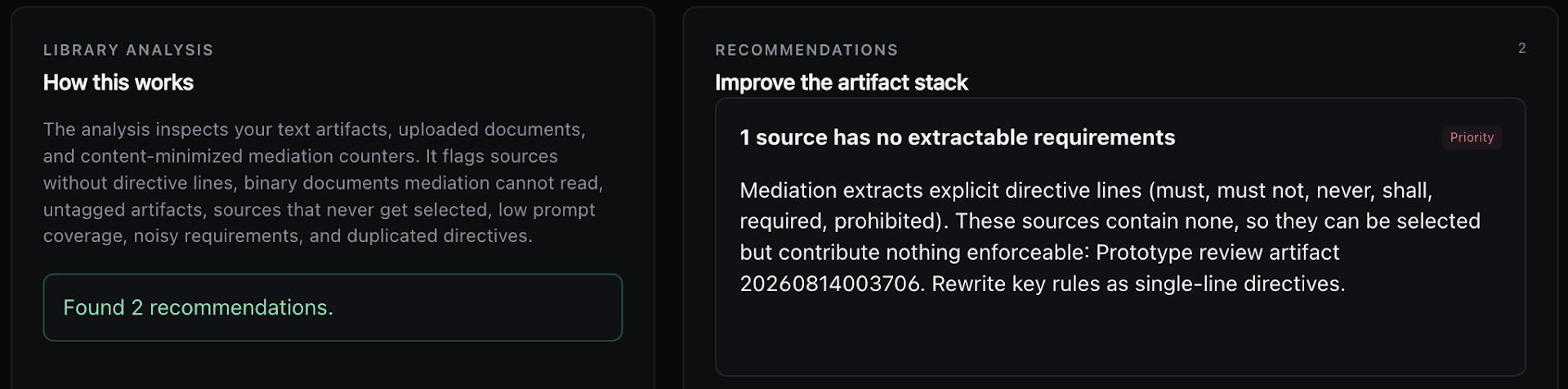
Outer Syntax inspects the context library and identifies artifacts that cannot yet contribute enforceable guidance.

  • Find sources without directive requirements
  • Prioritize the highest-impact remediation
  • Give context owners a specific rewrite path
Working productExample workspace data
View larger
Outer Syntax library analysis identifies two recommendations and prioritizes an example workspace source with no extractable directive requirements.
Working productExample workspace data
View larger
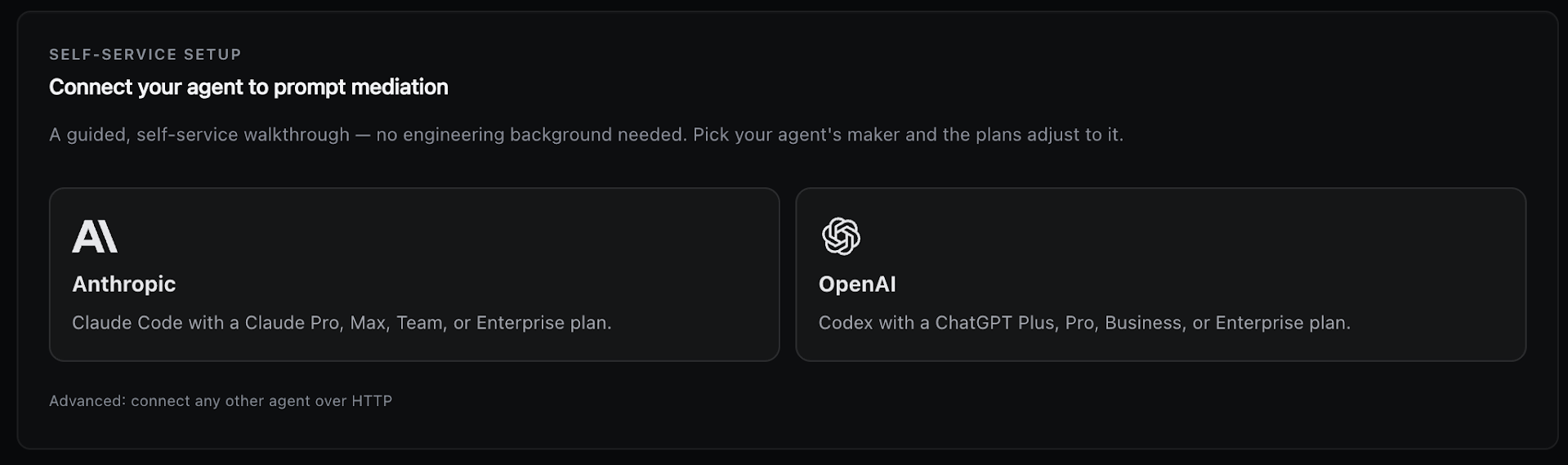
Outer Syntax self-service setup offers guided prompt mediation connections for Claude Code and Codex plus an HTTP option.
02 / Connect

Start mediating prompts without an AI integration project.

The working product provides guided setup paths for Claude Code and Codex, plus an HTTP option for other agent systems.

  • Choose the agent client already in use
  • Follow a provider-specific connection plan
  • Keep an advanced HTTP path for custom systems

The context gap

AI decisions inherit every weakness in the context path.

When every application assembles context differently, teams lose the shared control and evidence needed to operate enterprise AI with confidence.

  1. 01

    Logic fragments

    Retrieval and prompt rules are repeated across teams, agents, and applications.

    No shared control point
  2. 02

    Context drifts

    Stale or inappropriate material can reach a request without consistent curation and policy.

    Quality varies by path
  3. 03

    Influence disappears

    Teams struggle to explain which knowledge and rules shaped a model output.

    Decisions are hard to review

The context lifecycle

Manage context as a continuous enterprise system.

Outer Syntax places curation, policy, delivery, validation, and learning in one operating loop around the AI systems teams already use.

  1. 01 Source

    Connect organizational knowledge and policy categories.

  2. 02 Curate

    Shape material into approved organizational context.

  3. 03 Govern

    Apply clear rules for what can inform each request.

  4. 04 Deliver

    Assemble relevant context at the point of use.

  5. 05 Validate

    Evaluate outputs against the context and expectations.

  6. 06 Observe

    See how context is used, performs, and needs refinement.

A context decision, made visible

See what enters a request, why it belongs, and what happens next.

This representative trace shows the control point between a request and a model interaction. It is an explanatory workflow, not a released product interface.

Inputs
Intent, approved knowledge, and policy
Decision
Relevant context selected under a governing rule
Evidence
Output validation and usage signals return to owners
Illustrative workflow Context decision / request path
Incoming request

What approval is required for this purchase?

Intent classified
Decision path active
Governing rule Use current approved policy for the requester's region
KNOWLEDGE

Current procurement policy

Included as approved guidance
POLICY

Regional approval thresholds

Included for the requester's region
ARCHIVE

Superseded procurement policy

Excluded from delivery

DeliveredSelected context moves with the request.

ValidatedOutput is evaluated against expectations.

ObservedUsage signals return to context owners.

One system, clear ownership

Give every team the control it needs.

A common context layer connects platform speed with organizational oversight without forcing each team into the same job.

BUILD

AI platform teams

Centralize context delivery so shared logic does not have to be rebuilt in every AI application.

Outcome: a consistent foundation for builders.
GOVERN

Security and governance

Make policy part of the context path and improve the ability to review what influenced an output.

Outcome: control that stays close to execution.
CURATE

Knowledge owners

Manage approved organizational context and see where use and quality signals call for refinement.

Outcome: context with accountable ownership.
DELIVER

Application teams

Use relevant context at request time while retaining the models, agents, and applications chosen for the job.

Outcome: faster delivery with fewer one-off rules.

A distinct layer in the stack

Context control complements the systems around it.

Outer Syntax governs context across an enterprise AI stack. It does not claim to replace every gateway, retrieval system, knowledge platform, or observability tool.

Gateways

Control traffic and access at model boundaries.

Outer Syntax controls the context carried through the request.

RAG systems

Retrieve material for a query.

Outer Syntax adds lifecycle-wide curation, policy, validation, and observation.

Knowledge systems

Store and organize enterprise information.

Outer Syntax shapes approved information for AI consumption.

Observability tools

Measure application and model behavior.

Outer Syntax focuses insight on context use and performance.

Architecture neutral by design

Place context control between enterprise sources and AI consumers.

This reference architecture uses generic system categories. It communicates where Outer Syntax sits without claiming named integrations or a specific deployment mode.

Discuss your architecture

Enterprise trust

Evaluate trust from verified information, not vague promises.

Draft assurance content. Security and legal review is required before these statements become verified public assurances.

Outer Syntax does not separately store or retain customer data outside the customer's dedicated tenant, does not use customer data to train models, does not sell customer data, and does not use customer data for purposes beyond providing and securing the customer's service.

Each customer receives a dedicated tenant designed as a secure enclave, with customer data encrypted in transit across approved service paths using documented transport-security controls.

Why this team

Built for the hard part of enterprise AI.

Outer Syntax sits where security, AI architecture, and enterprise operations meet. Samuel and Daniel have spent their careers defending these systems, building them, and making them governable.

Their backgrounds put them close to the scale, security, and governance problems Outer Syntax is built to solve.

Co-founder

Samuel Kaufman

Cyber defense and security leadership

Samuel brings more than 18 years in cyber defense and security engineering, spanning penetration testing, defensive operations, cloud security, and security leadership. His background includes AWS and Coinbase. He knows where trust breaks under pressure.

LinkedIn profile

Co-founder

Daniel Glassow

Enterprise AI and cloud architecture

Daniel designs high-stakes enterprise platforms around AI agents, AWS automation, security engineering, and governed workflows. He has worked at AWS and brings the systems discipline to make context, policy, and evidence work together at enterprise scale.

LinkedIn profile

Architecture review

Find the control point in your AI stack.

Tell us how context moves through your current AI architecture and where governance, delivery, validation, or observation needs stronger control.

  • Describe your current architecture
  • Identify the control gaps
  • Receive a focused follow-up

Prefer email? Contact sales@outersyntax.com.

What should the review focus on?

Your submission is delivered to the Outer Syntax sales mailbox. Request deletion at sales@outersyntax.com. Do not submit passwords, secrets, customer data, or other confidential material.